'%3e%3cpath%20fill='red'%20d='M0%200h720v480H0z'/%3e%3cpath%20fill='%23000095'%20d='M0%200h360v240H0z'/%3e%3cg%20fill='%23fff'%3e%3cpath%20d='m154%20126.9-2.5%209.6%209.4%202.6-1.8-7.1zm46.9%205.1-1.8%207.1%209.4-2.6-2.5-9.6zm-41.8-24-5.1%205.1%201.9%206.9z'/%3e%3cpath%20d='m155.9%20120-1.9%206.9%205.1%205.1z'/%3e%3cpath%20d='m154%20113.1-6.9%206.9%206.9%206.9%201.9-6.9zm14%2027.8%205.1%205.1%206.9-1.9zm18.9%205.1%209.6%202.5%202.6-9.4-7.1%201.8z'/%3e%3cpath%20d='m192%20140.9%207.1-1.8%201.8-7.1zm-31.1-1.8%202.6%209.4%209.6-2.5-5.1-5.1zm19.1%205%206.9%201.9%205.1-5.1z'/%3e%3cpath%20d='m173.1%20146%206.9%206.9%206.9-6.9-6.9-1.9zm-12.2-45.1-9.4%202.6%202.5%209.6%205.1-5.1zm-1.8%2031.1%201.8%207.1%207.1%201.8zm45-12%201.9-6.9-5.1-5.1z'/%3e%3cpath%20d='m168%2099.1-7.1%201.8-1.8%207.1zm32.9%208.9-1.8-7.1-7.1-1.8zm5.1%2018.9%206.9-6.9-6.9-6.9-1.9%206.9z'/%3e%3cpath%20d='m200.9%20108-8.9-8.9-12-3.2-12%203.2-8.9%208.9-3.2%2012%203.2%2012%208.9%208.9%2012%203.2%2012-3.2%208.9-8.9%203.2-12z'/%3e%3cpath%20d='m200.9%20132%205.1-5.1-1.9-6.9zm5.1-18.9%202.5-9.6-9.4-2.6%201.8%207.1zm-6.9-12.2-2.6-9.4-9.6%202.5%205.1%205.1zm-26-6.9-9.6-2.5-2.6%209.4%207.1-1.8zm6.9%201.9-6.9-1.9-5.1%205.1z'/%3e%3cpath%20d='m186.9%2094-6.9-6.9-6.9%206.9%206.9%201.9z'/%3e%3cpath%20d='m192%2099.1-5.1-5.1-6.9%201.9zM173.1%20146l-9.6%202.5%204.5%2016.6%2012-12.2zm-5.1%2019.1%2012%2044.9%2012-44.9-12-12.2zm-7.1-26-9.4-2.6-4.4%2016.4%2016.4-4.4z'/%3e%3cpath%20d='m147.1%20152.9-12%2045.1%2032.9-32.9-4.5-16.6zm-12-20.9L102%20165.1l45.1-12.2%204.4-16.4z'/%3e%3cpath%20d='m154%20126.9-6.9-6.9-12%2012%2016.4%204.5zm0-13.8-2.5-9.6-16.4%204.5%2012%2012z'/%3e%3cpath%20d='M135.1%20108%2090%20120l45.1%2012%2012-12zm90%2024-16.6%204.5%204.4%2016.4%2045.1%2012.2z'/%3e%3cpath%20d='m199.1%20139.1-2.6%209.4%2016.4%204.4-4.4-16.4zm-12.2%206.9-6.9%206.9%2012%2012.2%204.5-16.6zm19.1-19.1%202.5%209.6%2016.6-4.5-12.2-12z'/%3e%3cpath%20d='m192%20165.1%2033.1%2032.9-12.2-45.1-16.4-4.4zm7.1-64.2%209.4%202.6%204.4-16.4-16.4%204.4z'/%3e%3cpath%20d='M225.1%20108%20258%2075.1l-45.1%2012-4.4%2016.4zm-12.2-20.9L225.1%2042%20192%2075.1l4.5%2016.4zm12.2%2044.9%2044.9-12-44.9-12-12.2%2012z'/%3e%3cpath%20d='m206%20113.1%206.9%206.9%2012.2-12-16.6-4.5zm-38-38L135.1%2042l12%2045.1%2016.4%204.4z'/%3e%3cpath%20d='m160.9%20100.9%202.6-9.4-16.4-4.4%204.4%2016.4z'/%3e%3cpath%20d='m147.1%2087.1-45.1-12%2033.1%2032.9%2016.4-4.5zm39.8%206.9%209.6-2.5-4.5-16.4-12%2012z'/%3e%3cpath%20d='M192%2075.1%20180%2030l-12%2045.1%2012%2012z'/%3e%3cpath%20d='m173.1%2094%206.9-6.9-12-12-4.5%2016.4z'/%3e%3c/g%3e%3ccircle%20cx='180'%20cy='120'%20r='51.1'%20fill='%23000095'/%3e%3ccircle%20cx='180'%20cy='120'%20r='45.1'%20fill='%23fff'/%3e%3c/g%3e%3c/svg%3e)
'%20d='m0%200%2016%2011h61%2061%2061%2061%2060L47%2037h61%2061%2060%2061L16%2063h61%2061%2061%2061%2060L47%2089h61%2061%2060%2061L16%20115h61%2061%2061%2061%2060L47%20141h61%2061%2060%2061L16%20166h61%2061%2061%2061%2060L47%20192h61%2061%2060%2061L16%20218h61%2061%2061%2061%2060L0%200'/%3e%3c/svg%3e)

'%20d='M-50-12v24m6%200v-24m6%200v24m76%200V1m0-2v-11m6%200v11m0%202v11m6%200V1m0-2v-11'/%3e%3cpath%20transform='rotate(-33.69006752598)'%20d='M-50-12v24m6%200V1m0-2v-11m6%200v24m76%200V1m0-2v-11m6%200v24m6%200V1m0-2v-11'/%3e%3c/g%3e%3cg%20transform='rotate(33.69006752598)'%3e%3cpath%20fill='%23cd2e3a'%20d='M12%200a18%2018%200%2011-36%200%2024%2024%200%201148%200'/%3e%3cpath%20fill='%230047a0'%20d='M0%200a12%2012%200%201124%200%2024%2024%200%2011-48%200%2012%2012%200%201024%200'/%3e%3c/g%3e%3c/svg%3e)


Fukuoka City Car Rental Guide: The Rules That Shape Driving in Hakata and Tenjin
Most people searching for a car rental in central Fukuoka want the same thing: they are staying in Hakata or Tenjin, they plan to drive out to Yufuin, Aso or Nagasaki the next morning, and they want to know where to collect the car. GoodCars will give the answer up front — in Fukuoka, picking up in the city centre barely makes sense, because the airport is extraordinarily close to town. What will actually decide how smoothly your trip goes is something else: the set of rules this city applies to parking, lanes and road space. Almost nobody writes about them in a rental context, and every one of them can cost you twenty minutes or a fine.

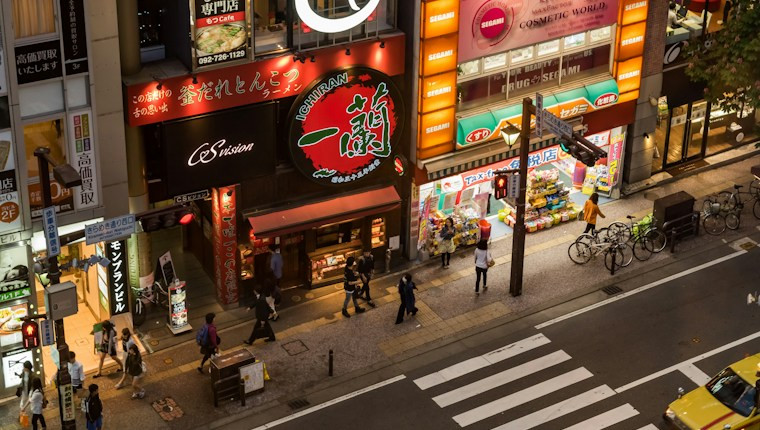
Driving in Fukuoka is not difficult — what catches visitors out are the rules written on the signs (illustrative image)
The short answer: Fukuoka does not need a downtown branch
GoodCars operates its Fukuoka pickup point at Fukuoka Airport, with no separate city-centre branch. In most cities that would be a drawback. In Fukuoka it is the opposite, for one reason: Fukuoka Airport is the closest major international airport to a city centre anywhere in Japan. The subway takes roughly 5 minutes from Fukuoka Airport station to Hakata, and about 11 minutes to Tenjin — shorter than the walk many travellers would face from a hotel to a so-called downtown branch.
| Where you are staying | To the GoodCars pickup point | GoodCars recommends |
|---|---|---|
| Around Hakata Station | About 5 minutes by subway | Leave luggage at the hotel and travel light to collect the car |
| Tenjin / Nakasu area | About 11 minutes by subway | Same — no need to drag bags onto the subway |
| Arriving the same day | Collect inside the terminal | Drive straight onto the expressway without entering the city |
⚠️ One trap in the layout: the rental counters are in the international terminal, but the subway only serves the domestic terminal. Coming in from the city, you arrive on the domestic side and still need the free inter-terminal shuttle (about 10 minutes) to reach the rental counters on the first floor of the international terminal. Build that into your timing. The counter locations and shuttle flow are covered in detail in the Fukuoka Airport car rental pickup guide.

Five minutes to Hakata by subway — the real reason Fukuoka needs no downtown rental branch (illustrative image)
If your plan is two days in central Fukuoka and then a longer drive on day three, do not rent from day one. The subway and buses cover the city comfortably, and a parked car simply accrues parking charges. Take the subway out to the airport on the morning you actually leave, collect the car and head straight for the expressway.
The urban expressway charges a flat fare, not by distance

The Fukuoka Urban Expressway is an elevated loop with a pricing logic unlike ordinary toll roads (illustrative image)
This is the single rule GoodCars most wants visiting drivers to understand. Most Japanese expressways charge by distance. The Fukuoka Urban Expressway does not: a standard car pays a flat 630 yen in cash whether you travel one interchange or the entire network.
That changes how you plan. Since the cost is identical either way, dropping off the expressway to avoid a toll is pointless here — it only adds traffic lights. Conversely, for a short hop such as Hakata to Tenjin, the flat fare is poor value and surface roads are the sensible choice.
| Payment method / time band | Standard car | GoodCars notes |
|---|---|---|
| Cash, any time | 630 yen | No discounts at all |
| ETC, Saturdays | About 590 yen | ETC only |
| ETC, Sundays and public holidays | About 560 yen | ETC only |
| ETC, late night and early morning (roughly 22:00–07:00) | About 560 yen | Applies every day of the week |
| ETC, designated sections in the night band | From about 450 yen | Section-specific; follow posted signage |
The table says it plainly: every discount on the Fukuoka Urban Expressway is ETC-only, and cash gets nothing. The per-trip gap looks small, but a Fukuoka itinerary often enters and leaves the urban expressway several times a day, and the long-distance Kyushu Expressway sections outside the city add up quickly. Note too that the Dazaifu interchange connects directly to the urban expressway and collects both the intercity and urban expressway portions at once — passing through on ETC removes any chance of getting the payment wrong. Card rental is explained in the complete guide to renting a car in Japan.
Once you leave the city, intercity driving times and whether a Kyushu expressway pass pays off are a separate decision, covered in the complete Kyushu car rental guide. For a loop that never doubles back, see the five-day Kyushu loop itinerary.
Parking in Tenjin and Hakata: affordable, but height is the catch

In urban Japan, what stops you parking is rarely the space — it is the bar over the entrance (illustrative image)
The good news first: parking in central Fukuoka is noticeably cheaper than in Tokyo, Osaka or Kyoto. The ranges GoodCars sees are roughly these:
| Area / type | Typical maximum rate | Notes |
|---|---|---|
| Around Hakata Station, weekday 24 hours | About 800–1,400 yen | Five minutes further on foot makes a real difference |
| Around Hakata Station, weekend 24 hours | About 1,500–2,400 yen | Weekends cost more here, the reverse of business districts |
| Tenjin, daytime cap | About 800–1,000 yen (often an 08:00–22:00 band) | Time-banded caps are the norm |
| Tenjin, overnight cap | About 300–400 yen (often a 22:00–08:00 band) | Leaving the car overnight costs very little |
In other words, the Tokyo argument of "parking is too expensive, so do not rent" does not hold in Fukuoka. What will genuinely leave you unable to park is vehicle height.
⚠️ Japanese urban car parks have two height limits, not one. Mechanical stacker car parks usually cap total height at 1.55 m (higher-clearance machines above 1.75 m exist but remain a minority), while self-park and underground facilities are typically 2.1 m. Seven-seaters and most high-roof SUVs fail the 1.55 m line, and buildings in the city core lean heavily towards mechanical systems. GoodCars suggests that if you need a seven-seater, do not book accommodation in the heart of Tenjin or Hakata — choose a hotel with surface parking on the fringe instead.
Fukuoka City permits qualifying developments in the central area to provide their required parking off-site, or in consolidated facilities, rather than beneath the building itself. Add the large-scale Tenjin redevelopment programme, under which roughly seventy buildings are being rebuilt over the life of the scheme, and hoardings and temporary traffic arrangements are simply normal. Do not assume the building you are visiting has parking underneath it — locate a nearby time-based car park in advance.
The police publish which streets are enforced hardest

Parking enforcement in Fukuoka is not random, and where it is strictest is public information (illustrative image)
This is the point GoodCars finds most useful and least documented for visitors: Fukuoka Prefectural Police publish parking-enforcement guidelines online, with each police station mapping its own highest-priority routes, priority routes, highest-priority districts and priority districts. The Hakata station guideline, for example, covers Hakata Station, Gion, Nakasu-Kawabata and the Yoshizuka area — precisely where visitors are most likely to leave a car.
The force also publishes counts of the confirmation stickers actually affixed by officers and parking observers over a given period. The sticker is the yellow notice attached to an illegally parked vehicle, and once it has been applied, driving away does not end the matter — liability follows the registered user of the car.
⚠️ If a rental car is ticketed, the consequences follow you past the return. Illegal-parking liability in Japan is tied into the rental contract, and the hardest cases GoodCars has handled involve notices that arrive long after the customer has flown home. The simple rule: around Hakata Station and Nakasu, never think in terms of "just five minutes" — use a paid car park. The wider process is explained in the complete guide to renting a car in Japan.
Bus lanes changed from "exclusive" to "priority" — the rule most visitors misread

Fukuoka runs one of Japan's densest bus networks, and its main arteries carry lane regulations (illustrative image)
Three central arteries — Watanabe-dori, Sumiyoshi-dori and Taihaku-dori — were converted from bus exclusive lanes to bus priority lanes. For a visiting driver the distinction matters enormously:
- Exclusive bus lane: within the regulated hours, general traffic may not use the lane at all
- Priority bus lane: within the regulated hours, general traffic may use it, but must move aside for an approaching bus and must never obstruct one
Two cautions from GoodCars. First, the restriction applies only during the hours shown on the sign, and those hours are not standardised across Japan — read the signboard at the junction rather than relying on memory. Second, a priority lane is not a free pass: crawling along it during regulated hours and blocking a bus is still an offence.
If you are not confident reading local restrictions, keep to the right-hand lanes on main city arteries during commuting peaks — Japan drives on the left, so the leftmost lane is usually the bus lane. You may move slightly slower, but you never have to interpret a time band. The time you want to save is on the urban expressway, not on surface streets.
Yatai occupy the road from early evening, and the street narrows

Fukuoka's yatai legally occupy road space, which means the street changes shape after dark (illustrative image)
Fukuoka's yatai are not informal street vendors. They are licensed businesses operating under a city ordinance with formal road-occupancy permits. For food lovers that is a highlight; for drivers it is traffic information, because what they occupy is the road.
Under the city ordinance, yatai may occupy the road between 17:00 and 04:00 the following morning. There are on the order of a hundred of them, concentrated in Tenjin, Nakasu and Nagahama. On those blocks, from early evening onward, you gain a row of operating stalls and the crowds standing around them.
⚠️ GoodCars advises against driving into the dense yatai blocks of Nakasu and Tenjin at dinner time. It is not prohibited — it is simply the worst combination for an unfamiliar driver: narrowed carriageway, heavy pedestrian movement and taxis stopping constantly. Park in a nearby paid facility and walk. As noted above, overnight caps in Fukuoka often sit in the 300–400 yen range, which makes that an easy trade.
Official park-and-ride and fringe parking
If your pattern is driving out of the city by day and returning to a central hotel at night, Fukuoka runs two official schemes that are unusually well developed by Japanese standards.
| Scheme | How it works | When GoodCars would use it |
|---|---|---|
| Transit IC park-and-ride | Park at a participating time-based car park and pay with the same transit IC card (Hayakaken) used for the subway; the discount is applied automatically | Spending the day in Tenjin or Hakata without taking the car into the busiest blocks |
| Monthly park-and-ride | Holders of a subway commuter pass or a registered IC card get discounted monthly rates at designated lots, including suburban shopping-centre car parks | Longer stays; rarely relevant on a short trip |
| Fringe parking | At designated car parks, a stay of up to about 12 hours can be combined with a parking cap of around 500 yen plus a one-way subway ticket | The cheapest way to spend a single day in the city; both the Hakata and Tenjin areas have designated lots, some weekday-only |
Participating car parks, discount amounts and eligibility are set individually by operators and the city, and they are revised over time; not every car park offers a discount. GoodCars treats these as a bonus rather than a plan: never build an itinerary on the assumption that one specific car park will discount you. Confirm the current list on the city or subway website before departure.
Pickup points and the documents you must carry
The six GoodCars pickup points in Japan and the regions they serve are below. For Fukuoka and Kyushu, use the airport link:
| Pickup point | Region served | Booking link |
|---|---|---|
| Fukuoka Airport | Fukuoka city and all of Kyushu | View now |
| Narita Airport, Chiba | Tokyo and Kanto | View now |
| Haneda Airport | Tokyo and Kanto | View now |
| New Chitose Airport | Hokkaido | View now |
| Kansai Airport | Osaka and Kansai | View now |
| Naha Airport station | Okinawa | View now |
For most nationalities, driving in Japan requires an International Driving Permit issued in the Geneva Convention format, together with your home licence and passport. GoodCars must be explicit about the limits here, because this is where rentals fail at the counter. Japan recognises only the Geneva Convention format; an IDP issued in the Vienna Convention format is not valid in Japan, so check which format your issuing authority gave you rather than assuming any IDP will do. A small group of countries — including Switzerland, Germany, France, Belgium, Monaco, Estonia and Taiwan — instead drive on their original licence accompanied by an official Japanese translation issued by JAF or an embassy; self-made translations are not accepted. Licences issued in mainland China cannot be used to drive in Japan under any arrangement, including with an IDP. Your permission to drive runs for up to one year from your date of entry, and never beyond the expiry of the licence or permit itself.
See Fukuoka Airport pickup options
Frequently asked questions
Q1. I am staying in Hakata — must I really go to the airport to collect the car?
Yes, GoodCars collects at Fukuoka Airport. But as above, Hakata Station to Fukuoka Airport station is about 5 minutes by subway and Tenjin about 11 — less effort than reaching a downtown branch in most cities. Travel out light, collect the car and come back for your luggage.
Q2. Is central Fukuoka hard to drive in compared with Tokyo or Osaka?
GoodCars rates it as easier than either: wider carriageways, distinctly cheaper parking and a compact centre. The things to watch are the density of buses on the main arteries and the way yatai reshape certain blocks from early evening.
Q3. Do I have to use the urban expressway, or can I stay on surface roads?
For short hops such as Hakata to Tenjin, surface roads are fine. For anything leaving the city or crossing districts, take the expressway — the flat fare means dropping off to save money saves nothing and costs time.
Q4. What happens if I do not have an ETC card?
You can still drive, but you forfeit every discount. The Fukuoka Urban Expressway cash fare is a flat 630 yen, while ETC brings holiday and night travel down to around 560 yen. With long-distance Kyushu Expressway sections on top, GoodCars recommends renting the card with the car.
Q5. Will a seven-seater cause problems in the city?
Yes, and it is the most common on-the-ground issue. Car parks attached to city-centre buildings are predominantly mechanical, with height limits around 1.55 m, which excludes seven-seaters and high-roof SUVs. Choose a hotel with surface parking, or park on the fringe and take the subway in.
Q6. A yellow sticker has been placed on my car — what now?
That is a confirmation sticker recording an illegal-parking offence. Driving away does not make it go away; liability follows the vehicle's registered user and the notice will reach you through the rental contract. Contact GoodCars immediately and do not remove it yourself.
Q7. How far in advance should I arrange my IDP or translation?
Both take time and neither can be obtained in Japan at short notice for most travellers, so arrange yours before departure. Whichever you hold, carry it together with your original licence and passport — presenting the permit or translation alone will not be accepted at the counter.
Information currency: the fares, operating hours, traffic restrictions and park-and-ride benefits described here are indicative ranges compiled by GoodCars from public sources at the time of writing. Japanese toll rates and traffic regulations are revised periodically. Actual amounts and conditions are governed by on-site signage and by announcements from the operators, Fukuoka City and Fukuoka Prefectural Police — please confirm before you travel.
Driving eligibility: the documents required to drive in Japan depend on the country that issued your licence. Most drivers need an International Driving Permit in the Geneva Convention format plus their original licence; an IDP in the Vienna Convention format is not valid in Japan. A limited group of countries, including Taiwan, drive on their original licence with an official Japanese translation. Licences issued in mainland China cannot be used in Japan. If your documents do not meet the requirement, the counter will decline to release the vehicle and no refund can be made.