


Japan Cherry Blossom Road Trip: Following the Bloom North and When to Book Your Car
"Drive from Kyushu to Hokkaido, chasing the cherry blossoms all the way" sounds like the perfect road trip. The Japan Meteorological Agency's long-term averages tell a different story: Fukuoka and Tokyo bloom almost at the same time, while Hokkaido follows more than a month later. What you actually need to plan is not one long highway run, but two flights and three short drives.
GoodCars splits this route into Kyushu, the Tokyo outskirts and Hokkaido, all regions where you can book a pick-up point. This guide covers how to read the bloom dates, how to link the three legs, how to deal with peak-season traffic and parking, and when to book. Bloom dates shift every year, so treat the dates below as ranges and rely on the current season's published forecast.

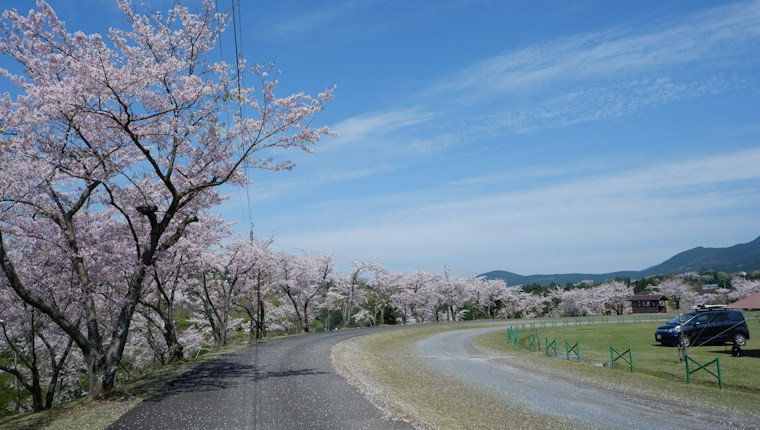
A car gets you to blossom roads that trains cannot reach, but you are racing every other hanami driver (illustrative image)
The cherry blossom front does not move evenly
The table below shows the Japan Meteorological Agency's long-term averages for Somei Yoshino first bloom and full bloom:
| City | Average first bloom | Average full bloom | Route leg |
|---|---|---|---|
| Fukuoka | 22 March | 31 March | Kyushu |
| Kumamoto | 22 March | 1 April | Kyushu |
| Tokyo | 24 March | 31 March | Tokyo outskirts |
| Yokohama | 25 March | 1 April | Tokyo outskirts |
| Hakodate | 28 April | 2 May | Hokkaido |
| Sapporo | 1 May | 6 May | Hokkaido |
Three things stand out. First, Fukuoka and Tokyo share the same average full-bloom date, so Kyushu and the Tokyo area fit into a single trip; there is no need to wait for the bloom to travel. Second, further south does not always mean earlier: Kagoshima's average first bloom is 26 March, later than Fukuoka, and its full bloom comes around 5 April. Third, full bloom to falling petals usually takes about a week, less with wind and rain, so never stake a trip on a single day.

The same city's bloom can move by around two weeks between years (illustrative image)
Two flights, three separate rentals
Fukuoka to Tokyo is more than 1,000 km by road, and Hokkaido lies across the sea beyond that. A week on the expressway costs you full bloom, tolls and energy. GoodCars recommends picking up and returning near each leg and flying between them:
| Leg | Usual window | Pick-up | Next step |
|---|---|---|---|
| Kyushu | Late March to early April | Fukuoka Airport | Fly Fukuoka to Narita, start the next leg the same day |
| Tokyo outskirts | Late March to early April | Narita Airport, Chiba Station, Kinshicho Station | About three to five weeks later, a separate trip to New Chitose |
| Hokkaido | Average: late April to early May; recent years: around mid to late April | New Chitose Airport | End of the route |
In practice there are two ways to do this. To see Honshu and Kyushu in one go, combine Kyushu and the Tokyo outskirts into a trip of seven to nine days; the order can follow whichever forecast comes first. To see late blossoms or avoid the late-March crowds, make Hokkaido its own trip. Fitting all three legs into one journey means staying in Japan for over a month on the long-term averages, and about three to five weeks in recent years, which is neither realistic nor necessary for most people.
This guide only covers regions where GoodCars has bookable pick-up points, so it skips central Japan and Tohoku. One-way rentals across regions are expensive and not always available, so plan on returning each car where you collected it.
Kyushu: Fukuoka's blossoms are in town, the driving is outside it
Kyushu's blossoms usually peak from late March to early April. Fukuoka's best-known spot is Maizuru Park at the Fukuoka Castle ruins, with around 1,000 trees of 19 varieties, a castle cherry blossom festival and paid night illumination in parts of the grounds. It is also exactly where you should not drive. There are paid car parks nearby, yet the organisers clearly ask visitors to use public transport because the area gets very congested. Akasaka and Ohorikoen subway stations are about 8 minutes on foot.
A smoother plan is to take the subway to Maizuru Park on arrival day, then collect the car the next morning and head out of town. For cross-prefecture driving times, see the Kyushu car rental guide.

Castle-ruin hanami sits in the city and parking is hard, so take the subway for this one (illustrative image)
The best reason to drive is the Akizuki Sugi-no-Baba blossom avenue in Asakura, an old castle town about 20 minutes from Amagi Interchange on the Oita Expressway. Know three things first: parking is paid, around 400 yen per visit for a standard car; the avenue is not pedestrian-only, so cars and walkers share it during hanami; and weekend traffic controls may apply, with queues backing up to the car park entrance. A weekday or an early weekend arrival makes a big difference.
With time to spare, the Isshingyo no Ozakura in Minamiaso, Kumamoto, is another option: a single great tree against rapeseed fields, also at its best in late March to early April. Entry fees, parking and access limits vary by year, and it is a long way from Fukuoka Airport, so treat it as a separate day rather than a stop after Akizuki.
Tokyo outskirts: keep the car in Chiba, out of central Tokyo
Central Tokyo's famous blossom spots are poorly suited to driving, with little parking, high charges and faster trains. A rental earns its keep on the outskirts, as the Tokyo and Kanto car rental guide explains. GoodCars picked three places that suit the pick-up points and have manageable parking:
| Spot | Nearby pick-up | Usual peak | Parking |
|---|---|---|---|
| Sakura no Yama, Narita | Narita Airport | Late March to early April | About 150 cars, free |
| Izumi Nature Park, Chiba City | Chiba Station | Late March to early April | About 250 cars, 400 yen per visit |
| Shimizu Park, Noda | Kinshicho Station | Late March to early April | Varies by car park, mostly hourly; 800 yen for 3 hours or more (higher in Golden Week) |
Sakura no Yama makes the ideal first or last stop: about 500 trees right beside the runway, with aircraft passing overhead, roughly 10 minutes from Narita Interchange. It suits both a fresh pick-up and the hour before you return the car, and first-time drivers on the left never need to enter the city. See the Narita Airport car rental guide for airport logistics. The free car park fills during the bloom, so weekday mornings are safest.

A blossom hill by the airport means hanami can start the moment you land (illustrative image)
Izumi Nature Park is free to enter, but it has a trap: the car park closes at 16:30 from October to March and 17:00 from April, and entry stops 30 minutes before closing. Arrive late on a March afternoon and you may be turned away. Overflow parking is arranged during the bloom; check the seasonal notice for details.

At suburban parks the trick is simply to arrive early; afternoons are the busiest (illustrative image)
If you travel in late February or early March, before the Somei Yoshino open, head to Kyonan in southern Chiba for Yoritomo-zakura, an early Kawazu-type cherry that usually peaks from mid-February to early March. The Sakuma Dam area is about 5 km from Kyonan-Tomiyama Interchange on the Futtsu-Tateyama Road. It is one of the few places near Tokyo with blossoms in February.
Hokkaido: the bloom runs close to Golden Week, and the mountains may still see snow
Hokkaido is a different trip altogether. On the long-term averages the bloom runs from late April to early May, seemingly right on Japan's Golden Week holidays, but recent years have moved it up to around mid to late April, and full bloom in Sapporo and Hakodate has mostly finished before the holidays begin. Golden Week is also when car prices, hotels and crowds all peak. Book early May by the averages and Sapporo and Hakodate may well be past full bloom; to catch it, shift the trip toward late April. The Hokkaido car rental guide covers the region overall.
- Maruyama Park, Sapporo: the city's classic blossom spot. The park car park charges per visit and fills during Golden Week, so the subway to Maruyama Koen Station is easiest.
- Shizunai Nijukken Road cherry avenue (Shinhidaka): a straight line of about 7 km with over 2,000 trees, mainly Ezo mountain cherry, and Hokkaido's most satisfying blossom drive. Allow about 1 hour 40 minutes from New Chitose Airport. It blooms a little after Sapporo, with sources quoting anything from late April to mid-May, so check the official festival notice.
- Goryokaku Park, Hakodate: around 1,500 trees, usually a few days ahead of Sapporo, but with no dedicated car park, so use nearby paid lots. It takes around half a day each way from New Chitose, so it is not a day trip; plan an overnight stay.

When the lowlands are in bloom, Hokkaido's mountains may still hold snow (illustrative image)
Peak-season traffic and parking: arrive before 10 a.m.
On a blossom trip the trouble is rarely the expressway; it is the last few kilometres around each famous spot. GoodCars suggests five habits:
- Arrive before 10 a.m. Car parks at major spots often fill during the morning and queues peak after lunch. Early morning is noticeably quieter.
- Choose a weekday. If full bloom lands on a weekend the crowds are far heavier, so shift your day if you can.
- Have a second car park ready. Save a backup 500 m to 1 km away in the navigation, and go there as soon as you see a queue.
- Do not stop beside blossom roads. Places like Nijukken Road allow parking only in marked bays. Roadside photo stops block traffic and risk a parking violation.
- Carry cash and 100-yen coins. Temporary car parks may not take cards.

Around famous spots, staff often direct traffic in season and the usual routes may change (illustrative image)
Golden Week also affects the expressways. Past NEXCO East forecasts show outbound peaks on the morning of around 3 May and inbound peaks on the evening of around 5 May, with queues of up to about 40 km on the Tohoku and Kan-Etsu expressways, and their notices state that weekend ETC discounts do not apply during Golden Week. Those are Honshu figures, but the message holds everywhere: leave plenty of margin on holiday return days. Do not tie your car return too tightly to a same-day flight; GoodCars recommends a generous buffer, especially for airport returns.
When to book: car first, forecast later
The hard part of a blossom trip is the timing gap: forecasts only start updating in winter and improve as the date nears, but popular cars will not wait. According to our Japan car rental price guide, book one to two months ahead for blossom-season weekends and about three months ahead for Golden Week. Rates and ways to save are all covered there, so here are just the three decisions specific to chasing blossoms:
- Use the averages to set a range, and keep it wide. Aim for late March to early April in Kyushu and the Tokyo area. Hokkaido averages late April to early May, but recent years have been around mid to late April, so lean earlier.
- Lock in the car and flights, then let the forecast change where you go each day. Changing a day's destination is much easier than changing a booking. Change and cancellation terms vary by supplier, so follow what the booking page shows.
- Choose small over big. Car parks at blossom spots and old-town streets tend to be tight. For two or three people, a compact car is far easier than an SUV.
You can book each leg separately, starting with the hardest. Generally Golden Week dates tighten first, followed by late-March weekends. The GoodCars Japan booking page shows the times and plans for each pick-up point.
Before you go: documents and cover
For most nationalities, driving in Japan requires an International Driving Permit in the 1949 Geneva Convention format, plus your home licence and passport. Vienna Convention format permits are not valid in Japan. Switzerland, Germany, France, Belgium, Monaco and Taiwan use the original licence with an official Japanese translation instead. Licences from mainland China and Indonesia cannot be used in Japan at all. Full details are in our complete guide to renting a car in Japan.
Collision damage waiver and the non-operation charge (NOC) are separate items, and the contents depend on the supplier's plan; when booking through GoodCars, follow what the booking page shows. Car park scrapes are the most common blossom-season incident, so check your cover before you set off.
Frequently asked questions
Q1. Can I drive all the way from Fukuoka to Sapporo following the blossoms?
In theory, yes, but it is not recommended. Fukuoka and Tokyo bloom almost together, so driving does not mean following the flowers, and Hokkaido is more than a month later on the averages, about three to five weeks in recent years, and across the sea. GoodCars suggests flying between legs and renting locally.
Q2. When is the best time to book?
One to two months ahead for blossom-season weekends and about three months ahead for Golden Week. Do not wait for a firm forecast, because the cars you want may be gone.
Q3. Where can I check the bloom forecast?
The Japan Weather Association's tenki.jp and Weathernews both publish forecasts, usually starting in winter, while the Japan Meteorological Agency reports actual bloom dates. Dates move with the weather, so check again a week before you go.
Q4. If I can only do one leg, which should I choose?
For a first self-drive trip, Kyushu or the Tokyo outskirts: stable weather, simple roads and late-March full bloom. Hokkaido means longer distances and a bloom right next to Golden Week, so it suits drivers with some experience in Japan.
Q5. Will I definitely see blossoms in Hokkaido during Golden Week?
There is no guarantee. Sapporo's average full bloom is around 6 May, but in recent years Sapporo and Hakodate have mostly reached full bloom in late April, before the holidays. To improve your odds, travel before the holidays or include a later spot such as Shizunai as a backup.
Q6. Do I need winter tyres in Hokkaido in early May?
Lowland roads are usually clear, but mountain areas can still see snow or ice. Whether a car has winter tyres depends on the supplier and date, so check the GoodCars booking page, and avoid mountain passes and night driving.
Q7. Do I need a car for hanami at all?
Not always. Maizuru Park, central Tokyo and Maruyama Park are easier by public transport. A car pays off at Akizuki, Sakura no Yama and Nijukken Road, which trains serve poorly. GoodCars recommends planning city and countryside separately.
- Narita Airport / Chiba Station / Kinshicho Station (Tokyo and Kanto)
- New Chitose Airport (Hokkaido)
- Fukuoka Airport (Kyushu)
- Naha Airport Station (Okinawa)