'%3e%3cpath%20fill='red'%20d='M0%200h720v480H0z'/%3e%3cpath%20fill='%23000095'%20d='M0%200h360v240H0z'/%3e%3cg%20fill='%23fff'%3e%3cpath%20d='m154%20126.9-2.5%209.6%209.4%202.6-1.8-7.1zm46.9%205.1-1.8%207.1%209.4-2.6-2.5-9.6zm-41.8-24-5.1%205.1%201.9%206.9z'/%3e%3cpath%20d='m155.9%20120-1.9%206.9%205.1%205.1z'/%3e%3cpath%20d='m154%20113.1-6.9%206.9%206.9%206.9%201.9-6.9zm14%2027.8%205.1%205.1%206.9-1.9zm18.9%205.1%209.6%202.5%202.6-9.4-7.1%201.8z'/%3e%3cpath%20d='m192%20140.9%207.1-1.8%201.8-7.1zm-31.1-1.8%202.6%209.4%209.6-2.5-5.1-5.1zm19.1%205%206.9%201.9%205.1-5.1z'/%3e%3cpath%20d='m173.1%20146%206.9%206.9%206.9-6.9-6.9-1.9zm-12.2-45.1-9.4%202.6%202.5%209.6%205.1-5.1zm-1.8%2031.1%201.8%207.1%207.1%201.8zm45-12%201.9-6.9-5.1-5.1z'/%3e%3cpath%20d='m168%2099.1-7.1%201.8-1.8%207.1zm32.9%208.9-1.8-7.1-7.1-1.8zm5.1%2018.9%206.9-6.9-6.9-6.9-1.9%206.9z'/%3e%3cpath%20d='m200.9%20108-8.9-8.9-12-3.2-12%203.2-8.9%208.9-3.2%2012%203.2%2012%208.9%208.9%2012%203.2%2012-3.2%208.9-8.9%203.2-12z'/%3e%3cpath%20d='m200.9%20132%205.1-5.1-1.9-6.9zm5.1-18.9%202.5-9.6-9.4-2.6%201.8%207.1zm-6.9-12.2-2.6-9.4-9.6%202.5%205.1%205.1zm-26-6.9-9.6-2.5-2.6%209.4%207.1-1.8zm6.9%201.9-6.9-1.9-5.1%205.1z'/%3e%3cpath%20d='m186.9%2094-6.9-6.9-6.9%206.9%206.9%201.9z'/%3e%3cpath%20d='m192%2099.1-5.1-5.1-6.9%201.9zM173.1%20146l-9.6%202.5%204.5%2016.6%2012-12.2zm-5.1%2019.1%2012%2044.9%2012-44.9-12-12.2zm-7.1-26-9.4-2.6-4.4%2016.4%2016.4-4.4z'/%3e%3cpath%20d='m147.1%20152.9-12%2045.1%2032.9-32.9-4.5-16.6zm-12-20.9L102%20165.1l45.1-12.2%204.4-16.4z'/%3e%3cpath%20d='m154%20126.9-6.9-6.9-12%2012%2016.4%204.5zm0-13.8-2.5-9.6-16.4%204.5%2012%2012z'/%3e%3cpath%20d='M135.1%20108%2090%20120l45.1%2012%2012-12zm90%2024-16.6%204.5%204.4%2016.4%2045.1%2012.2z'/%3e%3cpath%20d='m199.1%20139.1-2.6%209.4%2016.4%204.4-4.4-16.4zm-12.2%206.9-6.9%206.9%2012%2012.2%204.5-16.6zm19.1-19.1%202.5%209.6%2016.6-4.5-12.2-12z'/%3e%3cpath%20d='m192%20165.1%2033.1%2032.9-12.2-45.1-16.4-4.4zm7.1-64.2%209.4%202.6%204.4-16.4-16.4%204.4z'/%3e%3cpath%20d='M225.1%20108%20258%2075.1l-45.1%2012-4.4%2016.4zm-12.2-20.9L225.1%2042%20192%2075.1l4.5%2016.4zm12.2%2044.9%2044.9-12-44.9-12-12.2%2012z'/%3e%3cpath%20d='m206%20113.1%206.9%206.9%2012.2-12-16.6-4.5zm-38-38L135.1%2042l12%2045.1%2016.4%204.4z'/%3e%3cpath%20d='m160.9%20100.9%202.6-9.4-16.4-4.4%204.4%2016.4z'/%3e%3cpath%20d='m147.1%2087.1-45.1-12%2033.1%2032.9%2016.4-4.5zm39.8%206.9%209.6-2.5-4.5-16.4-12%2012z'/%3e%3cpath%20d='M192%2075.1%20180%2030l-12%2045.1%2012%2012z'/%3e%3cpath%20d='m173.1%2094%206.9-6.9-12-12-4.5%2016.4z'/%3e%3c/g%3e%3ccircle%20cx='180'%20cy='120'%20r='51.1'%20fill='%23000095'/%3e%3ccircle%20cx='180'%20cy='120'%20r='45.1'%20fill='%23fff'/%3e%3c/g%3e%3c/svg%3e)
'%20d='m0%200%2016%2011h61%2061%2061%2061%2060L47%2037h61%2061%2060%2061L16%2063h61%2061%2061%2061%2060L47%2089h61%2061%2060%2061L16%20115h61%2061%2061%2061%2060L47%20141h61%2061%2060%2061L16%20166h61%2061%2061%2061%2060L47%20192h61%2061%2060%2061L16%20218h61%2061%2061%2061%2060L0%200'/%3e%3c/svg%3e)

'%20d='M-50-12v24m6%200v-24m6%200v24m76%200V1m0-2v-11m6%200v11m0%202v11m6%200V1m0-2v-11'/%3e%3cpath%20transform='rotate(-33.69006752598)'%20d='M-50-12v24m6%200V1m0-2v-11m6%200v24m76%200V1m0-2v-11m6%200v24m6%200V1m0-2v-11'/%3e%3c/g%3e%3cg%20transform='rotate(33.69006752598)'%3e%3cpath%20fill='%23cd2e3a'%20d='M12%200a18%2018%200%2011-36%200%2024%2024%200%201148%200'/%3e%3cpath%20fill='%230047a0'%20d='M0%200a12%2012%200%201124%200%2024%2024%200%2011-48%200%2012%2012%200%201024%200'/%3e%3c/g%3e%3c/svg%3e)


Refuelling in Japan: Self-Service Pumps, Nozzle Colours and the Full-Tank Return Rule

GoodCars represents local Japanese suppliers, and two things go wrong at the return counter more often than anything else. One is forgetting to refill the tank. The other is far more expensive: putting the wrong fuel in. The first costs a modest surcharge. The second can mean a repair bill in the hundreds of thousands of yen, and it is usually not covered by any waiver you bought.
This guide does not repeat the licence, cost and pick-up basics already covered in the complete guide to renting a car in Japan. It deals with one topic only: fuel. How a Japanese self-service pump actually works, when nozzle colours can be trusted and when they cannot, what misfuelling really costs, how the full-tank return rule is settled, what fuel currently costs, and which routes force you to treat refuelling as a scheduled stop.
- Green means diesel in Japan. If you learned to drive somewhere green means unleaded, this is the single most dangerous habit to bring with you
- Nozzle colour coding is a legal standard at self-service stations only; staffed stations set their own colours
- Japanese pumps are not pay-at-pump in the American sense: you choose fuel and amount first, then settle at a separate payment machine
- No octane numbers. Japan sells only "Regular" and "High-Octane" petrol, plus diesel and kerosene
- A self-service nozzle that will not dispense is usually waiting for staff approval, not broken
- National average petrol is around ¥170 per litre; motorway stations run about ¥20 per litre higher
- Roughly 381 of Japan's 1,700-plus municipalities have fewer than four fuel stations inside their boundaries
Three things to confirm before you drive away

Almost every refuelling mistake traces back to something that was not checked at pick-up. Add these three to your walk-around; together they take under a minute.
1. Which fuel this specific car takes
The overwhelming majority of Japanese rental cars run on Regular petrol. Imported and higher-spec models may specify High-Octane, and some vans and SUVs are diesel. You can confirm it three ways: the label inside the filler flap, the owner's manual in the glovebox, or simply asking the counter. The most reliable habit is to photograph the inside of the filler flap during the pick-up walk-around, so you are not relying on memory at the pump.
2. Which side the filler is on
You can check this from the driver's seat: there is a small triangular arrow next to the fuel gauge, and it points to the side the filler cap is on. Nearly all recent models have it. If yours does not, on Japanese domestic models the filler is usually on the opposite side to the exhaust. It sounds trivial, but pulling up on the wrong side at a self-service station means the hose will not reach and you generally have to queue again for another bay.
3. Which fuel rule your contract uses
Full tank out, full tank back is the Japanese standard, though some operators offer distance-based fuel settlement instead. Confirm with GoodCars which one applies to your booking at the time you reserve, rather than an hour before drop-off.
How a Japanese self-service pump actually works

The sequence, in order
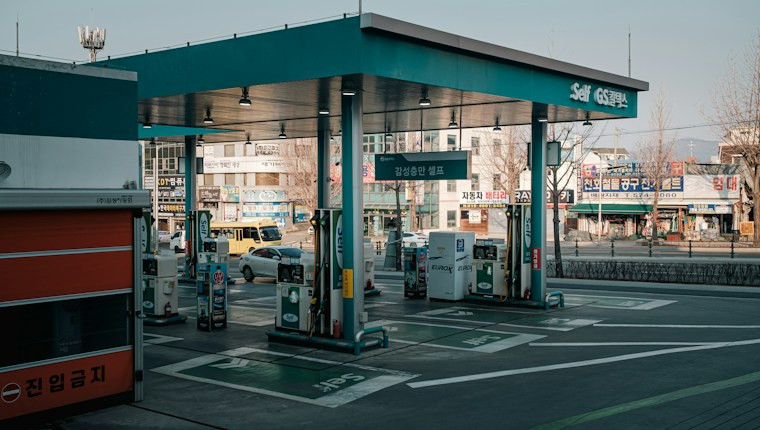
- Park, switch off the engine, apply the parking brake — filler side facing the pump
- Touch the static discharge pad first, with bare hands, before you open the filler flap
- Select fuel type and quantity on the machine — choose mantan for a full tank
- Choose your payment method: cash, credit card or prepaid card
- Take the correct nozzle and insert it fully
- Squeeze until it clicks off automatically, then stop — do not top up
- Return the nozzle, close the cap, then go to the separate payment machine for your receipt and change
Note the last step. Japan is not a pay-at-pump country in the American sense. On many machines you pay or pre-authorise at the pump terminal and then collect your receipt and change from a standalone settlement machine a few metres away. Visitors regularly drive off without their change because they did not know that machine existed.
Staffed stations: easy, but the colours no longer apply
At a full-service station you simply wind the window down and say "regular, mantan". But here is the detail almost nobody mentions: the legal colour standard applies to self-service stations only. Staffed stations choose their own nozzle colours, with no national rule. So do not check the attendant's work by colour — say the fuel type out loud.
Language and payment: plan for the worst case
Pump screens are primarily in Japanese. Some machines offer an English toggle, but you cannot count on it. GoodCars suggests a practical fallback: learn the shape of three words on screen — レギュラー (Regular), ハイオク (High-Octane), 軽油 (diesel) — and follow the icons for everything else. On payment, most stations take cards, but overseas-issued cards are sometimes declined by unattended pump terminals. Carrying enough cash, or using a staffed station, avoids the problem entirely.
Misfuelling: a six-figure yen bill that insurance usually will not cover

This is the section to read twice. In the UK and a number of other markets, green traditionally marks unleaded petrol and diesel is black. Europe has moved to shape-based labels — a circle with E for petrol, a square with B for diesel — precisely because colour conventions never agreed with each other. Japan uses neither system. Its self-service colour code is fixed by fire regulations, and in that code green is diesel.
| Nozzle colour | Japanese name | What it is | Common in rentals? |
|---|---|---|---|
| Red | レギュラー | Regular petrol (research octane around 90) | The vast majority |
| Yellow | ハイオク | High-octane petrol (research octane around 100) | Imports, higher-spec models |
| Green | 軽油 | Diesel | Some vans and SUVs |
| Blue | 灯油 | Kerosene — never for vehicles | Not applicable |
Petrol in a diesel engine, or diesel in a petrol engine, causes real damage to the fuel system and the engine itself. Repair bills commonly land in the ¥200,000 to ¥300,000 range. The bigger problem is cover: misfuelling is generally treated as driver error rather than an accidental event, so collision damage waivers and excess-reduction products routinely exclude it, and rental contracts assign the cost to the driver.
Returning the car full: keep the receipt

Major Japanese operators state it plainly: return the car with a full tank. If you do not, the fuel charge is calculated from the distance driven, and — a detail that surprises most people — hybrids and non-hybrids are settled on different bases. The per-litre rate applied is noticeably higher than what you would pay yourself, which makes this one of the most avoidable charges on the whole rental.
Keep the receipt
Counters frequently ask to see the fuel receipt, especially if you filled up at a self-service station or somewhere well away from the branch. Stations used to issue a formal fuelling certificate; these days the till receipt is normally accepted. GoodCars suggests one combined habit: fill up within a few kilometres of the return branch and put the receipt straight into your passport wallet.
Allow more time than you think
Schedule the fill-up thirty minutes before drop-off; stations near airports queue during peak departure windows. And there is one location-specific trap worth flagging.
What fuel actually costs right now
Japan publishes a weekly official survey of average retail fuel prices, nationally and by region, which makes budgeting unusually easy. At recent levels, Regular petrol averages around ¥170 per litre nationally, with regional spreads of roughly five yen — the Kyushu and Okinawa region sits at the higher end, the Chubu region at the lower end.
The tax structure just changed, so old figures overstate it
Anything you read from a few years ago will now be too high. The old provisional petrol tax rate of about ¥25.1 per litre has been abolished, and the provisional rate on the diesel levy has come down from ¥32.1 to ¥15.0 per litre. Retail prices still move with crude and the exchange rate, so check the current weekly average when you plan — but budget from today's number, not an old article's.
One more myth worth retiring: Okinawa is not automatically cheaper. It is the only prefecture with a petrol tax reduction, but that reduction has been scaled back and island logistics push prices up, so pump prices there are not reliably below the mainland.
Motorway fuel costs more — you are buying time
Fuel at expressway service areas typically runs about ¥20 per litre above ordinary roads, with extreme cases exceeding ¥30. The reason is structural: of roughly 233 fuel stations on the expressway network, around 174 operate around the clock, and that staffing shows up in the price. On the motorway you are buying availability, not value. If your route allows it, exit and refuel on a local road.
- A compact car returning about 15 km per litre, fuel at ¥170 per litre
- 200 km in a day ≈ 13 litres ≈ about ¥2,200
- For an SUV or eight-seater, recalculate at 9 to 11 km per litre
- GoodCars states the model and fuel type at quotation, so this goes into your budget before you book
When refuelling has to be a scheduled stop

In cities, fuel is never a problem. Three situations are, and all three are solved before you leave, not during.
1. Long gaps between motorway fuel stops
The extreme case is in Hokkaido: on the Doto Expressway, after Yuni parking area there is no fuel station for roughly 160 km towards Kushiro and about 180 km towards Kitami. The expressway operator runs a specific countermeasure — at designated interchanges you may exit to refuel and rejoin without the toll changing — but it only helps if you knew about it. GoodCars covers Hokkaido's long distances and winter conditions in the complete guide to renting a car in Hokkaido.
2. Areas that simply have very few stations
The number of fuel stations in Japan has been falling for years. Of the country's 1,700-plus municipalities, around 381 — more than one in five — contain fewer than four stations, and a dozen or so have none at all. Those are frequently exactly the places you rented a car to reach. The more worthwhile the destination, the more likely fuel is scarce.
3. Opening hours
Rural and mountain stations often close in the early evening, and Sunday closure is common. Round-the-clock operation is concentrated in cities and at expressway service areas. In summer the long daylight makes it easy to assume a station will still be open when it is not.
- Refuel whenever the gauge drops below half — do not wait for a quarter
- Fill up before leaving a city area, especially for mountain, peninsula and island routes
- Mark the last station on your route in advance, with its opening hours
Six pick-up points, six different fuel realities

The same task looks different depending on where you collect the car. Use this table to work out which leg of your trip needs the attention.
| Pick-up point | Region | What matters for fuel |
|---|---|---|
| New Chitose Airport | Hokkaido | Long distances and a 100 km-plus gap in the east; fill up before leaving the Sapporo area |
| Kansai Airport | Osaka / Kansai | No public fuel station on the airport island — refuel before crossing the bridge |
| Fukuoka Airport | Kyushu | Plenty of choice in the city, but mountain stations around Aso and Takachiho close early |
| Naha Airport | Okinawa | Dense in Naha, thinner in the north and on ferry routes; prices are not automatically low |
| Narita Airport | Tokyo / Kanto | Stations near the airport queue at peak; add thirty minutes before drop-off |
| Haneda Airport | Tokyo / Kanto | Many self-service sites but tight forecourts; check your filler side before pulling in |
The Okinawa row deserves a note: itineraries there typically run north, and station density in the centre and north is well below Naha — see the GoodCars complete guide to renting a car in Okinawa. For Kyushu's mountain routes, plan your stops alongside the complete guide to renting a car in Kyushu.
Frequently asked questions
Q1. Does Japan sell 91, 95 or 98 octane?
No. Japanese pumps are labelled by name, not number: Regular (research octane roughly 90 in practice) and High-Octane (roughly 100). There is also diesel and kerosene, and kerosene must never go into a vehicle. Almost all rental cars take Regular.
Q2. Is green petrol or diesel?
Green is diesel in Japan. If you are used to green meaning unleaded, this is the habit most likely to cost you money here. The colour code is legally fixed at self-service stations; at staffed stations there is no national standard at all.
Q3. The nozzle will not dispense. Is the pump broken?
Usually not. A staff member inside must confirm the forecourt on a monitor and grant approval before fuel flows. Wait a few seconds and look towards the kiosk; if nothing happens, move to another bay or ask for help.
Q4. What happens if I return the car without refilling?
You are charged for fuel based on the distance driven, at a rate well above what you would pay at a pump, and hybrids are calculated differently from conventional cars. GoodCars recommends scheduling the fill-up into your last day and keeping the receipt.
Q5. Will my overseas credit card work?
Most stations accept cards, but unattended pump terminals sometimes decline overseas-issued cards. Carry enough cash as a fallback, or use a staffed station where a person processes the payment.
Q6. How much should I budget per day?
For a compact car at roughly 15 km per litre and fuel around ¥170 per litre, 200 km costs about ¥2,200. Expressway service areas add roughly ¥20 per litre, so exit and refuel locally when the route allows.
Q7. What if I am low on fuel on an expressway?
Check the distance to the next service area that actually has a fuel station — gaps in eastern Hokkaido exceed 100 km. Some sections allow you to exit for fuel and rejoin without the toll changing. Ask GoodCars about your specific route when you book.
The whole article in one line: in Japan, refuelling is expensive to get wrong and simple to get right. Confirm the fuel type and filler side at pick-up, touch the static pad before opening the flap, pause for a second whenever you see a green nozzle, and fill up thirty minutes before drop-off with the receipt in hand. Do those four things and fuel stops being a variable in your trip. GoodCars represents local Japanese suppliers and can confirm the vehicle's fuel type and the return policy at the time you book; for documents, costs and the pick-up process, see the complete guide to renting a car in Japan.