'%3e%3cpath%20fill='red'%20d='M0%200h720v480H0z'/%3e%3cpath%20fill='%23000095'%20d='M0%200h360v240H0z'/%3e%3cg%20fill='%23fff'%3e%3cpath%20d='m154%20126.9-2.5%209.6%209.4%202.6-1.8-7.1zm46.9%205.1-1.8%207.1%209.4-2.6-2.5-9.6zm-41.8-24-5.1%205.1%201.9%206.9z'/%3e%3cpath%20d='m155.9%20120-1.9%206.9%205.1%205.1z'/%3e%3cpath%20d='m154%20113.1-6.9%206.9%206.9%206.9%201.9-6.9zm14%2027.8%205.1%205.1%206.9-1.9zm18.9%205.1%209.6%202.5%202.6-9.4-7.1%201.8z'/%3e%3cpath%20d='m192%20140.9%207.1-1.8%201.8-7.1zm-31.1-1.8%202.6%209.4%209.6-2.5-5.1-5.1zm19.1%205%206.9%201.9%205.1-5.1z'/%3e%3cpath%20d='m173.1%20146%206.9%206.9%206.9-6.9-6.9-1.9zm-12.2-45.1-9.4%202.6%202.5%209.6%205.1-5.1zm-1.8%2031.1%201.8%207.1%207.1%201.8zm45-12%201.9-6.9-5.1-5.1z'/%3e%3cpath%20d='m168%2099.1-7.1%201.8-1.8%207.1zm32.9%208.9-1.8-7.1-7.1-1.8zm5.1%2018.9%206.9-6.9-6.9-6.9-1.9%206.9z'/%3e%3cpath%20d='m200.9%20108-8.9-8.9-12-3.2-12%203.2-8.9%208.9-3.2%2012%203.2%2012%208.9%208.9%2012%203.2%2012-3.2%208.9-8.9%203.2-12z'/%3e%3cpath%20d='m200.9%20132%205.1-5.1-1.9-6.9zm5.1-18.9%202.5-9.6-9.4-2.6%201.8%207.1zm-6.9-12.2-2.6-9.4-9.6%202.5%205.1%205.1zm-26-6.9-9.6-2.5-2.6%209.4%207.1-1.8zm6.9%201.9-6.9-1.9-5.1%205.1z'/%3e%3cpath%20d='m186.9%2094-6.9-6.9-6.9%206.9%206.9%201.9z'/%3e%3cpath%20d='m192%2099.1-5.1-5.1-6.9%201.9zM173.1%20146l-9.6%202.5%204.5%2016.6%2012-12.2zm-5.1%2019.1%2012%2044.9%2012-44.9-12-12.2zm-7.1-26-9.4-2.6-4.4%2016.4%2016.4-4.4z'/%3e%3cpath%20d='m147.1%20152.9-12%2045.1%2032.9-32.9-4.5-16.6zm-12-20.9L102%20165.1l45.1-12.2%204.4-16.4z'/%3e%3cpath%20d='m154%20126.9-6.9-6.9-12%2012%2016.4%204.5zm0-13.8-2.5-9.6-16.4%204.5%2012%2012z'/%3e%3cpath%20d='M135.1%20108%2090%20120l45.1%2012%2012-12zm90%2024-16.6%204.5%204.4%2016.4%2045.1%2012.2z'/%3e%3cpath%20d='m199.1%20139.1-2.6%209.4%2016.4%204.4-4.4-16.4zm-12.2%206.9-6.9%206.9%2012%2012.2%204.5-16.6zm19.1-19.1%202.5%209.6%2016.6-4.5-12.2-12z'/%3e%3cpath%20d='m192%20165.1%2033.1%2032.9-12.2-45.1-16.4-4.4zm7.1-64.2%209.4%202.6%204.4-16.4-16.4%204.4z'/%3e%3cpath%20d='M225.1%20108%20258%2075.1l-45.1%2012-4.4%2016.4zm-12.2-20.9L225.1%2042%20192%2075.1l4.5%2016.4zm12.2%2044.9%2044.9-12-44.9-12-12.2%2012z'/%3e%3cpath%20d='m206%20113.1%206.9%206.9%2012.2-12-16.6-4.5zm-38-38L135.1%2042l12%2045.1%2016.4%204.4z'/%3e%3cpath%20d='m160.9%20100.9%202.6-9.4-16.4-4.4%204.4%2016.4z'/%3e%3cpath%20d='m147.1%2087.1-45.1-12%2033.1%2032.9%2016.4-4.5zm39.8%206.9%209.6-2.5-4.5-16.4-12%2012z'/%3e%3cpath%20d='M192%2075.1%20180%2030l-12%2045.1%2012%2012z'/%3e%3cpath%20d='m173.1%2094%206.9-6.9-12-12-4.5%2016.4z'/%3e%3c/g%3e%3ccircle%20cx='180'%20cy='120'%20r='51.1'%20fill='%23000095'/%3e%3ccircle%20cx='180'%20cy='120'%20r='45.1'%20fill='%23fff'/%3e%3c/g%3e%3c/svg%3e)
'%20d='m0%200%2016%2011h61%2061%2061%2061%2060L47%2037h61%2061%2060%2061L16%2063h61%2061%2061%2061%2060L47%2089h61%2061%2060%2061L16%20115h61%2061%2061%2061%2060L47%20141h61%2061%2060%2061L16%20166h61%2061%2061%2061%2060L47%20192h61%2061%2060%2061L16%20218h61%2061%2061%2061%2060L0%200'/%3e%3c/svg%3e)

'%20d='M-50-12v24m6%200v-24m6%200v24m76%200V1m0-2v-11m6%200v11m0%202v11m6%200V1m0-2v-11'/%3e%3cpath%20transform='rotate(-33.69006752598)'%20d='M-50-12v24m6%200V1m0-2v-11m6%200v24m76%200V1m0-2v-11m6%200v24m6%200V1m0-2v-11'/%3e%3c/g%3e%3cg%20transform='rotate(33.69006752598)'%3e%3cpath%20fill='%23cd2e3a'%20d='M12%200a18%2018%200%2011-36%200%2024%2024%200%201148%200'/%3e%3cpath%20fill='%230047a0'%20d='M0%200a12%2012%200%201124%200%2024%2024%200%2011-48%200%2012%2012%200%201024%200'/%3e%3c/g%3e%3c/svg%3e)


Northern Okinawa Self-Drive Route: Churaumi Aquarium, Kouri Island and Cape Manzamo in One Day
Three places dominate every northern Okinawa itinerary: the Churaumi Aquarium inside Ocean Expo Park, Kouri Island, and Cape Manzamo. What actually decides whether the day works is not whether you visit them, but which leg you drive on the expressway, which car park you aim for, and what time each place closes. In GoodCars' experience, people rarely get stuck at the attractions themselves — they get stuck on the stretch of ordinary road that still remains after the expressway ends, and on the traffic heading back into Naha at dusk.

The highlight of this route is a series of very real driving legs (illustrative image)
Can you really do this in one day? Add up the four legs first
Here are the numbers. GoodCars splits the route into four legs, starting from the Naha Airport branch, heading north along the west coast, and turning back at Cape Manzamo:
| Leg | Distance / time | GoodCars note |
|---|---|---|
| Naha Airport branch → Kyoda IC (Okinawa Expressway) | approx. 57 km / 50–60 min | The island's only expressway, and it ends at Kyoda |
| Kyoda IC → Ocean Expo Park | approx. 38 min | Still on ordinary roads: follow signs for Route 58 → Route 449 → Prefectural Road 114 |
| Ocean Expo Park → Kouri Island | approx. 30 min | Via Yagaji Island and the Kouri Bridge |
| Kouri Island → Cape Manzamo → Naha Airport branch | approx. 1 hr + approx. 1 hr | South along the west coast; Manzamo is the natural turning point |
Pure driving time is roughly four hours. That matches the official benchmark: Naha Airport to Ocean Expo Park takes about 2 hours by expressway and about 2 hours 50 minutes entirely on ordinary roads. Add 2–3 hours at the aquarium, an hour on Kouri Island and 30–40 minutes at Manzamo, and the day runs nine to ten hours.
This is an "out by eight, back in Naha by early evening" day, not a relaxed one. If you fly out that afternoon or have to return the car the same evening, GoodCars suggests cutting the aquarium entirely and keeping Kouri Island and Cape Manzamo — neither has a hard closing time to race against. For how the whole Okinawa trip should be split across days, see the Okinawa 4-day 3-night self-drive itinerary; this article only covers how to actually drive the northern day.
Leaving Naha: expressway or Route 58?

Same destination, almost an hour apart depending on the road you choose (illustrative image)
This is the first and most consequential choice of the day. The official figures: about 2 hours via the expressway, about 2 hours 50 minutes on ordinary roads. That 50-minute-to-an-hour gap is the difference between enjoying the main tank and rushing past it.
On cost: the Okinawa Expressway from Naha IC to Kyoda IC covers roughly 57.3 km and runs about ¥1,040 with an ETC card versus about ¥1,610 in cash — cash is roughly 50% more, a gap of about ¥570. One Okinawa-specific rule from GoodCars: the local expressway discounts are ETC-only, and the holiday discount does not apply in Okinawa (the late-night discount does). Travelling at the weekend will not earn you an automatic reduction the way it might on the mainland, so whether you carry an ETC card is a straight price difference.
- Naha to Kyoda: take the expressway. The time you save matters far more than the money — three more stops are waiting
- Kyoda to Churaumi: no choice, ordinary roads only. The expressway ends at Kyoda and about 38 minutes of driving remain. Many people assume they have arrived once they exit, then spend the rest of the day chasing the clock
- The southbound return: it depends on time. Get back on the expressway if you are returning the car; if not, Route 58 along the west coast is the hidden reward of this route
ETC card rental and how Japan's separate toll systems differ are covered in full in the GoodCars complete guide to renting a car in Japan.
Parking at Ocean Expo Park: nine free car parks, but only two worth chasing

Parking here costs nothing — the competition is over how far you walk (illustrative image)
The good news first: all nine car parks at Ocean Expo Park are free. That is unusual for a major Japanese attraction and it is why this route costs so little in parking. But free does not mean easy — what matters is which one you get.
| Car park | Location / capacity | GoodCars advice |
|---|---|---|
| P7 (North, multi-storey) | North Gate / approx. 1,083 spaces | First choice. The largest, and on the aquarium side |
| P6 | In front of North Gate / approx. 71 | Closest of all, but only 71 spaces and it fills early |
| P9 (Emerald Gate) | approx. 153 | The first fallback when P7 is full |
| P2 / P3 / P5 | Central Gate area / approx. 101–175 | Workable, with a longer walk |
| P1 (South Gate) / P8 | approx. 60–68 | Furthest from the aquarium; not worth it for this trip |
⚠️ P7 and P9 have a 2.3 m height limit. Ordinary compacts and SUVs are fine, but if you rented a high-roof van or the car has a roof rack, check the height before you reach the barrier. Height limits are standard at Japanese car parks — the GoodCars complete guide to renting a car in Japan explains the differences between types.
In practice: the North Gate lots (P6, P7) are busiest in the morning and ease off in the afternoon. If you follow this article and visit the aquarium early, accept that you may circle for a space. Flip the order and parking gets easier, but you will be watching the closing time.
Churaumi Aquarium: morning and afternoon are two different days

This is the only stop of the day with a hard closing time (illustrative image)
Because it is the only fixed-hours stop, the aquarium is the pivot of the schedule. The baseline hours are: aquarium and Churaumi Plaza 8:30–18:30, the rest of Ocean Expo Park 8:00–18:00, some facilities 8:30–17:30. In peak summer the aquarium extends its hours into the evening.
⚠️ The mistake that catches people out: last admission is one hour before closing. It is not "arrive by 18:30" — it is you cannot get in after 17:30. GoodCars has seen far too many travellers leave Kouri Island late and hit that line on arrival.
One recent change: Ocean Expo Park now runs "partial opening days" every Wednesday — the aquarium, dolphin shows and beach operate as normal, while the botanical garden and the history and folklore facilities close. In other words, a Wednesday visit is not wasted, but there is less to see around the park. The measure runs for a defined period, so GoodCars recommends checking the official site before you set out.
Not because it is quieter — it isn't — but because it is the only stop that closes. Put the time-limited item first and any later delay costs you nothing; do it the other way round and a single traffic jam wipes the aquarium off the day.
Kouri Island: you cannot stop on the bridge, so where do you park?

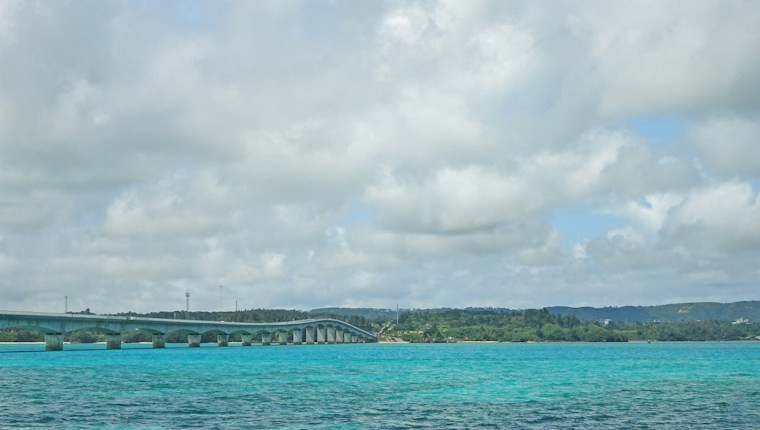
The Kouri Bridge is almost two kilometres long and toll-free, but stopping on it is prohibited (illustrative image)
The Kouri Bridge runs 1,960 metres and is toll-free — the second-longest toll-free bridge in the prefecture. The two minutes it takes to cross from Yagaji Island are probably the most photogenic stretch of the whole route.
⚠️ Stopping and waiting on the bridge is prohibited. This is the most common violation on this leg. Drive across and park on the island, or use the car park at either end and walk back. Beyond the fine, stopping on a busy tourist bridge is a genuine rear-end risk. Parking violations in Japan are tied to your car return process — the GoodCars complete guide to renting a car in Japan explains what follows.
Where to leave the car:
- The Kouri Beach car parks at both ends of the bridge — free. One side has showers and toilets. This is the cheapest option of the day
- Around the Heart Rock (Tiinu Beach) — paid, and the only parking fee you will pay all day. It sits about 5 minutes from the bridge and is served by four private car parks, typically from ¥300 per hour or ¥500 per day, with some in the ¥100–200 range. Keep some coins handy
- The swimming season runs roughly June to October, around 9:00–18:00, at no charge. You can still park and walk the beach out of season, but there are no lifeguards
GoodCars suggests budgeting one hour here: cross the bridge, spend twenty minutes at the beach, and decide on the Heart Rock based on whether you left the aquarium on time.
Cape Manzamo: the turning point, and the only ticket of the day

Manzamo sits right on the southbound return, so it costs no detour (illustrative image)
From Kouri Island it is about an hour south to Cape Manzamo in Onna Village. The official distance benchmarks make the geometry clear: Naha Airport to Kouri Island is about 85.5 km, roughly 1 hour 30 minutes by expressway; Naha Airport to Cape Manzamo is about 50 km, roughly 55 minutes on the Okinawa Expressway — so Manzamo falls neatly on the way home.
| Item | Detail |
|---|---|
| Viewing fee | ¥100 per person (pre-school children free) |
| Parking | Free. First car park approx. 97 car spaces, second approx. 218 |
| Opening hours | Apr–Oct 8:00–20:00 / Nov–Dec 8:00–18:00 / Jan–Mar 8:00–19:00 |
Those hours suit self-drivers well: open until eight in summer, which means a slow morning at the aquarium or a long stop on Kouri Island still leaves you time. GoodCars treats Manzamo as the buffer of the route — plenty of parking, a token fee, and a late closing time make it the stop least likely to be lost to delay.
The drive home, and two variations

The central east coast is a separate route, not a detour on this one (illustrative image)
Two timing warnings for the return from GoodCars:
- During Golden Week and the July–August peak, Route 58 between Onna Village and Nago jams at any hour. This is structural congestion caused by the resort belt, not a rush-hour effect. In peak season, add an hour to the return
- Naha city traffic heading inbound is heavy roughly 17:00–19:00, and weekday commuting runs about 7:00–9:00 and 17:30–19:30. If you are returning the car that day, build this in — the GoodCars Naha Airport car rental pickup guide covers return timing and shuttle buffers in detail
Give the time to Kouri Island and the Nakijin area instead, then collect Manzamo on the way back. The benefit is that nothing in the day has a closing time, which suits an afternoon pickup or an evening flight. GoodCars considers this the most underrated way to run the route.
The Kaichu Road runs 4.7 km and is toll-free, crossing shallow water on both sides, with a free car park at the midpoint and a roadside station for a break. It looks superb — but GoodCars has to be blunt: it is in Uruma City on the central east coast, the opposite direction from the Kouri Bridge. It is not on the way. Force both into one day and total driving passes six hours.
Treat it as an either/or: the east-coast sea road, or the northern west-coast route in this article.
One more error GoodCars sees constantly in Okinawa: booking every night in Naha and driving north each day. If two or more days of your trip are spent up north, move one night to Onna Village or Nago and you save close to two hours of driving daily. The Naha city car rental guide and the complete Okinawa car rental guide both explain how to match your accommodation to your pickup timing.
Frequently asked questions
Q1. Is one day genuinely enough?
Yes, provided you accept a full day. Driving alone is just over four hours; with three stops the day runs nine to ten hours. GoodCars suggests leaving Naha before 8am — and if you cannot, drop the aquarium.
Q2. Do I have to use the expressway?
No, but it costs you close to an hour (official benchmarks: about 2 hours by expressway, about 2 hours 50 minutes on ordinary roads). GoodCars recommends the expressway northbound to bank the time, and Route 58 along the west coast on the way back if you are not in a hurry.
Q3. How much should I budget for parking?
Surprisingly little. All nine Ocean Expo Park car parks are free, both Manzamo car parks are free, and the Kouri Beach car parks at either end of the bridge are free. The only paid parking is around the Heart Rock, typically from ¥300 per hour or ¥500 per day, with ¥100–200 options nearby. A handful of coins covers it.
Q4. Is a Wednesday visit to Ocean Expo Park a wasted trip?
No. Under the current partial opening arrangement, the aquarium, dolphin shows and beach operate as usual; the botanical garden and history and folklore facilities close. If the aquarium is your goal, Wednesday is fine. Check the official site for the current week before you go.
Q5. What licence documents do I need to drive in Okinawa?
For most nationalities: an International Driving Permit issued under the 1949 Geneva Convention, together with your home licence and passport. Japan recognises only the 1949 Geneva format — permits issued in the Vienna Convention format are not valid here. A small group of countries instead uses an official Japanese translation of the home licence rather than an IDP: Switzerland, Germany, France, Belgium, Monaco, Estonia and Taiwan (the translation must come from an authorised body; a self-made translation is not accepted). Chinese mainland licences cannot be used in Japan under any arrangement. You may drive for up to one year from your date of entry, or until your licence expires, whichever is shorter. Full details are in the GoodCars complete guide to renting a car in Japan.
Q6. Can I stop on the Kouri Bridge for photos?
No — stopping and waiting on the bridge are both prohibited. Park on the island, or use the free beach car park at either end and walk back. The bridge is toll-free and 1,960 metres long; the crossing takes two minutes, so there is no reason to risk it.
Q7. Can I add the Kaichu Road to this day?
GoodCars advises against it. The Kaichu Road is on the central east coast in Uruma City, the opposite direction from Churaumi and Kouri Island; combining them pushes total driving past six hours. Save it for a separate day.
Where to pick up your car with GoodCars
This route starts in Okinawa. The GoodCars pickup points in Japan are:
| Pickup point | Region | Book |
|---|---|---|
| Naha Airport branch | Okinawa | Check availability |
| Narita Airport, Chiba | Tokyo / Kanto | Check availability |
| Haneda Airport | Tokyo / Kanto | Check availability |
| New Chitose Airport | Hokkaido | Check availability |
| Kansai Airport | Osaka / Kansai | Check availability |
| Fukuoka Airport | Kyushu | Check availability |
Check Naha Airport pickup options
The northern day comes down to three things: take the expressway north, visit the aquarium in the morning, and expect to pay for parking only at the Heart Rock. Get those right and the rest of the day is yours. The GoodCars Okinawa pickup point sits at Naha Airport, so the first leg starts the moment you land.
Accuracy notice: driving times, opening hours, viewing fees, car park capacities and toll rates in this article are official announcements and market reference values verified at the time of writing, and may change with the season, events or policy. Ocean Expo Park's partial opening days, the aquarium's extended summer hours and Cape Manzamo's seasonal hours in particular are subject to change — please confirm on each operator's official website before you travel.
Licence and regulation notice: the documents required to drive in Japan depend on where your licence was issued. Most countries use a 1949 Geneva Convention International Driving Permit; a small group, including Taiwan, uses an official Japanese translation instead; Chinese mainland licences cannot be used. Rules may be revised, so please confirm current requirements with your issuing authority or the Japanese police before departure. GoodCars accepts no liability for rentals refused due to incomplete documentation.