'%3e%3cpath%20fill='red'%20d='M0%200h720v480H0z'/%3e%3cpath%20fill='%23000095'%20d='M0%200h360v240H0z'/%3e%3cg%20fill='%23fff'%3e%3cpath%20d='m154%20126.9-2.5%209.6%209.4%202.6-1.8-7.1zm46.9%205.1-1.8%207.1%209.4-2.6-2.5-9.6zm-41.8-24-5.1%205.1%201.9%206.9z'/%3e%3cpath%20d='m155.9%20120-1.9%206.9%205.1%205.1z'/%3e%3cpath%20d='m154%20113.1-6.9%206.9%206.9%206.9%201.9-6.9zm14%2027.8%205.1%205.1%206.9-1.9zm18.9%205.1%209.6%202.5%202.6-9.4-7.1%201.8z'/%3e%3cpath%20d='m192%20140.9%207.1-1.8%201.8-7.1zm-31.1-1.8%202.6%209.4%209.6-2.5-5.1-5.1zm19.1%205%206.9%201.9%205.1-5.1z'/%3e%3cpath%20d='m173.1%20146%206.9%206.9%206.9-6.9-6.9-1.9zm-12.2-45.1-9.4%202.6%202.5%209.6%205.1-5.1zm-1.8%2031.1%201.8%207.1%207.1%201.8zm45-12%201.9-6.9-5.1-5.1z'/%3e%3cpath%20d='m168%2099.1-7.1%201.8-1.8%207.1zm32.9%208.9-1.8-7.1-7.1-1.8zm5.1%2018.9%206.9-6.9-6.9-6.9-1.9%206.9z'/%3e%3cpath%20d='m200.9%20108-8.9-8.9-12-3.2-12%203.2-8.9%208.9-3.2%2012%203.2%2012%208.9%208.9%2012%203.2%2012-3.2%208.9-8.9%203.2-12z'/%3e%3cpath%20d='m200.9%20132%205.1-5.1-1.9-6.9zm5.1-18.9%202.5-9.6-9.4-2.6%201.8%207.1zm-6.9-12.2-2.6-9.4-9.6%202.5%205.1%205.1zm-26-6.9-9.6-2.5-2.6%209.4%207.1-1.8zm6.9%201.9-6.9-1.9-5.1%205.1z'/%3e%3cpath%20d='m186.9%2094-6.9-6.9-6.9%206.9%206.9%201.9z'/%3e%3cpath%20d='m192%2099.1-5.1-5.1-6.9%201.9zM173.1%20146l-9.6%202.5%204.5%2016.6%2012-12.2zm-5.1%2019.1%2012%2044.9%2012-44.9-12-12.2zm-7.1-26-9.4-2.6-4.4%2016.4%2016.4-4.4z'/%3e%3cpath%20d='m147.1%20152.9-12%2045.1%2032.9-32.9-4.5-16.6zm-12-20.9L102%20165.1l45.1-12.2%204.4-16.4z'/%3e%3cpath%20d='m154%20126.9-6.9-6.9-12%2012%2016.4%204.5zm0-13.8-2.5-9.6-16.4%204.5%2012%2012z'/%3e%3cpath%20d='M135.1%20108%2090%20120l45.1%2012%2012-12zm90%2024-16.6%204.5%204.4%2016.4%2045.1%2012.2z'/%3e%3cpath%20d='m199.1%20139.1-2.6%209.4%2016.4%204.4-4.4-16.4zm-12.2%206.9-6.9%206.9%2012%2012.2%204.5-16.6zm19.1-19.1%202.5%209.6%2016.6-4.5-12.2-12z'/%3e%3cpath%20d='m192%20165.1%2033.1%2032.9-12.2-45.1-16.4-4.4zm7.1-64.2%209.4%202.6%204.4-16.4-16.4%204.4z'/%3e%3cpath%20d='M225.1%20108%20258%2075.1l-45.1%2012-4.4%2016.4zm-12.2-20.9L225.1%2042%20192%2075.1l4.5%2016.4zm12.2%2044.9%2044.9-12-44.9-12-12.2%2012z'/%3e%3cpath%20d='m206%20113.1%206.9%206.9%2012.2-12-16.6-4.5zm-38-38L135.1%2042l12%2045.1%2016.4%204.4z'/%3e%3cpath%20d='m160.9%20100.9%202.6-9.4-16.4-4.4%204.4%2016.4z'/%3e%3cpath%20d='m147.1%2087.1-45.1-12%2033.1%2032.9%2016.4-4.5zm39.8%206.9%209.6-2.5-4.5-16.4-12%2012z'/%3e%3cpath%20d='M192%2075.1%20180%2030l-12%2045.1%2012%2012z'/%3e%3cpath%20d='m173.1%2094%206.9-6.9-12-12-4.5%2016.4z'/%3e%3c/g%3e%3ccircle%20cx='180'%20cy='120'%20r='51.1'%20fill='%23000095'/%3e%3ccircle%20cx='180'%20cy='120'%20r='45.1'%20fill='%23fff'/%3e%3c/g%3e%3c/svg%3e)
'%20d='m0%200%2016%2011h61%2061%2061%2061%2060L47%2037h61%2061%2060%2061L16%2063h61%2061%2061%2061%2060L47%2089h61%2061%2060%2061L16%20115h61%2061%2061%2061%2060L47%20141h61%2061%2060%2061L16%20166h61%2061%2061%2061%2060L47%20192h61%2061%2060%2061L16%20218h61%2061%2061%2061%2060L0%200'/%3e%3c/svg%3e)

'%20d='M-50-12v24m6%200v-24m6%200v24m76%200V1m0-2v-11m6%200v11m0%202v11m6%200V1m0-2v-11'/%3e%3cpath%20transform='rotate(-33.69006752598)'%20d='M-50-12v24m6%200V1m0-2v-11m6%200v24m76%200V1m0-2v-11m6%200v24m6%200V1m0-2v-11'/%3e%3c/g%3e%3cg%20transform='rotate(33.69006752598)'%3e%3cpath%20fill='%23cd2e3a'%20d='M12%200a18%2018%200%2011-36%200%2024%2024%200%201148%200'/%3e%3cpath%20fill='%230047a0'%20d='M0%200a12%2012%200%201124%200%2024%2024%200%2011-48%200%2012%2012%200%201024%200'/%3e%3c/g%3e%3c/svg%3e)


Naha City Car Rental Guide: Staying on Kokusai-dori or in Shintoshin? How to Time Your Pickup and Return
A lot of Okinawa trips start or end with a night in Naha itself: Kokusai-dori is walkable, Shintoshin has the big shopping malls, and the airport is close. The question most people get wrong is whether they actually need a car on their Naha city days. Pick up the moment you land and the car may sit in a hotel car park for two nights; pick up later and you have to work out where. This GoodCars guide sorts out exactly how to schedule pickup and return when you are staying in central Naha. One fact up front: GoodCars' Okinawa pickup and return point is Naha Airport Station — there is no city-centre branch — so every option below shows how to combine an airport pickup with a city hotel without wasting money or time.

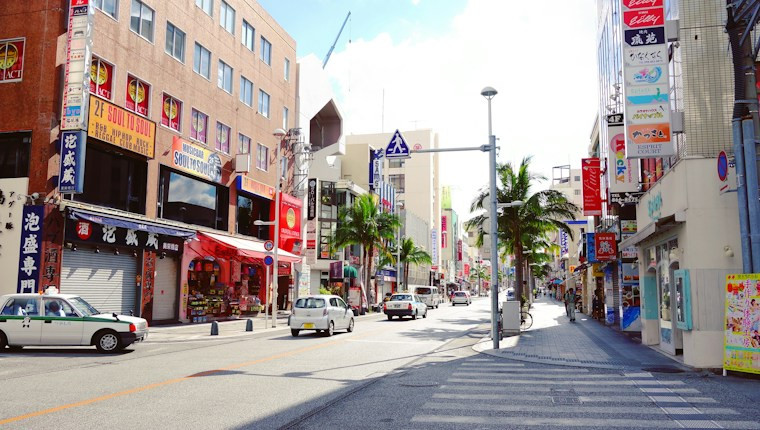
Around Kokusai-dori you can do everything on foot — a car is more burden than help here (illustrative photo)
General rental procedure, documents and insurance are covered in the complete guide to renting a car in Japan; island-wide costs, car classes and routes are in the Okinawa car rental guide. This article deals with one thing only: where your car should be, and when, on the days you sleep in Naha.
First Decide: Do You Need a Car on Your Naha City Days?

Kokusai-dori and the arcades around it are walking territory; driving in just means hunting for parking (illustrative photo)
Naha has a monorail, the Yui Rail, running through the city. Kokusai-dori, Makishi Public Market, Shuri Castle and Shintoshin are all on the line or within walking distance of it. GoodCars suggests deciding by where you are going that day, not by where you sleep:
| That day's plan | Car needed? | Why |
|---|---|---|
| Kokusai-dori, markets, Shuri Castle, Shintoshin shopping | No | Monorail plus walking links it all; a car means constant parking searches |
| The south: Gyokusendo, Sefa-utaki, seaside cafés | Yes | Few buses and widely spread sights |
| Central: American Village, Cape Zanpa, Kaichu Road | Yes | About an hour's drive from Naha; bus connections are slow |
| The north: Churaumi Aquarium, Kouri Island | Definitely | Often two hours or more each way — a day trip without a car is barely possible |
In short: you do not need a car on city days; you need one on the day you leave Naha. Get that straight and the pickup plan follows naturally.
Three Ways to Pick Up: On Arrival, Back at the Airport, or at a City Branch
In practice, travellers staying in central Naha have three options. GoodCars has laid out the costs and risks of each:
| Option | How it works | Best for | Costs to watch |
|---|---|---|---|
| A. Pick up on arrival | Collect the car the day you land and drive to your city hotel | People heading south or to central Okinawa on day one; families with older relatives or lots of luggage | Overnight parking in the city; evening rush hour on arrival day |
| B. No car on city days, pick up back at the airport | Take the monorail into town on arrival, then ride it back to Naha Airport Station on the day you leave the city | Anyone spending the first day or two in town; anyone who wants to save a rental day | One extra monorail ride plus the shuttle — allow about an hour |
| C. City-branch pickup | Collect from a branch near Kokusai-dori, Miebashi or Shintoshin | People with a fixed plan who happen to stay right next to a branch | Usually fewer car classes and shorter hours than airport branches; GoodCars currently offers airport-station pickup only in Naha |
If your first day or two are city-only, GoodCars recommends option B. The logic is simple: rentals in Japan are charged by time block, so not renting on city days means one less day of rental and one less night of hotel parking — and you never have to drive into Kokusai-dori at rush hour.
Say you land on the afternoon of day one and sleep near Kokusai-dori, explore south and north from day two, and fly out from the airport on day four. With option A you rent from day one afternoon to day four, and the car spends the first night in a hotel car park. With option B you ride the monorail back to the airport on the morning of day two — almost a full rental day shorter, and one night's parking saved. The only extra cost is a monorail ticket and roughly an hour of travel.
GoodCars works with local Japanese rental suppliers, and our Okinawa pickup point is Naha Airport Station. You can set the pickup time for the day you leave the city — it does not have to match your flight's arrival.
Option B Step by Step: Taking the Monorail Back to Naha Airport

From the Kokusai-dori area to the airport is just over ten minutes by monorail (illustrative photo)
The Yui Rail starts at Naha Airport Station. From Kenchomae Station at the west end of Kokusai-dori it takes a little over ten minutes; from Omoromachi Station in Shintoshin, around fifteen. Single fares are a few hundred yen. One-day and two-day passes (valid 24 or 48 hours from purchase) are available, and contactless credit cards are accepted at the gates. Fares have been revised in recent years, so check the Yui Rail website for current prices.
Once you reach the airport, GoodCars suggests budgeting time in this order:
- Monorail station to terminal: a walkway connects the station to the terminal's second floor — about five minutes with luggage.
- Second floor to the rental shuttle stop: go down to the arrivals level on the first floor and cross the road to the rental shuttle area.
- Shuttle to the rental office: no rental company sits right next to the terminal at Naha; every company runs a shuttle to an off-airport office. It is roughly ten minutes on a normal weekday, but peak-season queues can stretch the whole process to an hour.
The shuttle stop location, peak-season reality and the vehicle check are covered in our Naha Airport car rental pickup guide. From leaving your city hotel, allow about an hour plus check-in time — add another half hour in summer holidays and on long weekends.
A tip for airport pickups from the city: book your pickup for the time you will actually reach the rental office, not the time you board the monorail. Around 8–9 a.m. is one of the busiest windows at Naha's airport offices, because many travellers who stayed in the city collect cars then. If you can, book around 10 a.m. — the queue is usually far shorter.
Kokusai-dori or Shintoshin? The Real Difference for Parking and Driving

Coin car parks in Naha usually have a 24-hour maximum charge — far cheaper than Tokyo or Osaka (illustrative photo)
If you choose option A, the car lives in the city with you. Where you stay then makes a real difference:
- Around Kokusai-dori: narrow lanes, many one-way streets and lots of pedestrians and taxis. Hotel parking is often mechanical or arranged through nearby car parks. About ¥1,000–1,800 a night for a standard car is typical, and spaces are often first come, first served.
- Shintoshin (Omoromachi area): newer, wider roads, and more malls and hotels with flat or multi-storey self-park car parks. Getting in and out is noticeably easier.
- Coin car parks: many around Kokusai-dori have a 24-hour maximum charge, roughly ¥500–1,300 — much cheaper than Tokyo or Osaka.
Check vehicle height before booking a large car. Mechanical parking systems at city hotels commonly limit vehicles to 1.55 m in height (some bays allow 1.85 m), while self-park and underground car parks are typically around 2.1 m. Seven-seaters and high-roof SUVs may not fit mechanical bays. Ask the hotel whether its parking is mechanical or flat and what the height limit is, then choose your car class accordingly when booking with GoodCars.
GoodCars' conclusion: parking fees are not the real problem in Naha — time is. Hunting for spaces, waiting for a mechanical car park to return your car, crawling through traffic. That is why leaving the car out of your city days usually pays off.
Driving in Central Naha: Four Timing and Rule Traps

On weekday rush hours Kokusai-dori becomes a bus-only road (illustrative photo)
Naha has some of the worst traffic congestion of any Japanese city, and a few local rules surprise even visitors from mainland Japan. GoodCars sums them up in four points:
1. Bus lanes: off-limits on weekday mornings and evenings
Multi-lane arteries such as National Route 58 have bus-only lanes, while single-lane streets like Kokusai-dori become bus-only roads during the same periods. On Kokusai-dori the restriction runs 7:30–9:00 and 17:30–19:00 on weekdays, and does not apply on Saturdays, Sundays or public holidays. The penalty for driving in a bus-only lane is ¥6,000 and 1 point for a standard car; for a bus-only road it is ¥7,000 and 2 points. If the lane says バス専用 (bus only), stay out of it during those hours.
2. Sunday afternoons: Kokusai-dori is closed to cars
Every Sunday from 12:00 to 18:00, about 1.3 km of Kokusai-dori — from the Kencho-kitaguchi junction to the Saion-bashi junction — becomes a pedestrian mall, and ordinary vehicles are banned completely. It may be cancelled in bad weather, but do not count on it. If your hotel is on the street, plan a detour for any Sunday-afternoon pickup or return.
3. Weekday commuter peaks: inbound mornings, outbound evenings
On weekdays, traffic heads into the centre from about 7:00 to 9:00 and out towards the suburbs from about 16:30 to 19:30, on Routes 58 and 330 and the roads to the airport alike. Rain slows everything further. Locals avoid the peaks by leaving town before 7 a.m. or after 10 a.m., and coming back after 7:30 p.m.
4. Residential lanes: the limit is now 30 km/h
A recent change in Japan cut the default speed limit on residential roads without a centre line from 60 km/h to 30 km/h (about 19 mph) — and it applies without any sign. Naha's residential side streets and the narrow slopes around Shuri are textbook examples. Sat-navs love these short cuts; once you are in one, slow to 30.
During the Naha Otsunahiki festival, Route 58 around Kumoji is closed in the afternoon for the tug-of-war, Kokusai-dori has parade restrictions, and buses are diverted. If you are staying in the city then, avoid scheduling pickup or return in the afternoon.
Return Day: How Much Time to Allow from the City to the Airport

If your last night is in the city, consider returning the car the evening before (illustrative photo)
The return is where Naha trips most often go wrong. GoodCars recommends working backwards from your departure time:
- International flights: finish returning the car at least 3 hours before departure; domestic flights at least 2 hours.
- The return itself: refuelling, inspection and the shuttle back to the terminal take about 1.5 hours on a normal weekday, 2 hours in peak season.
- Rain or weekday evenings: add another hour. In Naha, a 20-minute drive taking an hour in the rain is nothing unusual.
The car must be returned with a full tank, and petrol stations near the rental offices have queues at peak return times, so fill up while you are still some distance from the airport.
If your flight home is in the morning and your last night is in central Naha, GoodCars recommends returning the car the evening before: drop it at Naha Airport Station, take the shuttle to the terminal, and ride the monorail back into town. Next morning, take the monorail straight to the airport — no commuter traffic, no petrol-station queue. Two monorail tickets buy you a flight you will not miss.
Documents: What You Need Depends on Where Your Licence Is From

Once you leave central Naha, the real Okinawa road trip begins (illustrative photo)
The requirements are the same whether you collect in the city or at the airport. GoodCars summarises them by licence origin:
- Most countries (US, UK, Australia, Canada, Singapore, Malaysia, Hong Kong, South Korea, Thailand and others): an International Driving Permit in the format of the 1949 Geneva Convention, plus your original home licence and passport. The IDP must be obtained in your home country before you travel — it cannot be issued inside Japan.
- Vienna Convention–format IDPs are not valid in Japan. Some countries issue both formats; ask for the Geneva format specifically.
- Switzerland, Germany, France, Belgium, Monaco and Taiwan: these countries use an official Japanese translation of your licence instead of an IDP, together with the original licence and passport.
- Mainland China and Indonesia: licences from these countries cannot be used to drive in Japan, even with an IDP.
You may drive for up to one year from your date of entry. Full details are in the complete guide to renting a car in Japan.
GoodCars has six pickup points in Japan; the same booking process works for all of them:
| Pickup point | Region | Book |
|---|---|---|
| Naha Airport Station | Okinawa main island (this guide) | Pick up in Naha |
| Narita Airport (Chiba) | Tokyo & Kanto | Pick up at Narita |
| Haneda Airport | Tokyo & Kanto | Pick up at Haneda |
| New Chitose Airport | Hokkaido | Pick up at New Chitose |
| Kansai Airport | Osaka, Kyoto & Kansai | Pick up at Kansai |
| Fukuoka Airport | Kyushu | Pick up at Fukuoka |
FAQ
Q1. Can I pick up a GoodCars rental on Kokusai-dori or in Shintoshin?
Not at the moment. GoodCars' Okinawa pickup and return point is Naha Airport Station. If you are staying in the city, take the monorail back to the airport — a little over ten minutes from Kenchomae or around fifteen from Omoromachi — and allow about an hour in total including the shuttle.
Q2. My first night is on Kokusai-dori. Should I pick up the car when I land?
It depends on day two. If day one is city-only and you leave town on day two, GoodCars suggests riding the monorail back to the airport on day two to collect the car — you save almost a full rental day and a night's parking. If you are heading south or to central Okinawa on day one, or travelling with older relatives or lots of luggage, picking up on arrival is simpler.
Q3. How much is hotel parking in central Naha?
Around ¥1,000–1,800 a night for a standard car is typical. Nearby coin car parks usually cap at roughly ¥500–1,300 per 24 hours. Mechanical bays often limit height to 1.55 m, so check with your hotel before booking a seven-seater or high-roof SUV.
Q4. When can I not drive on Kokusai-dori?
Two periods: weekdays 7:30–9:00 and 17:30–19:00, when it is a bus-only road; and every Sunday 12:00–18:00, when it is a pedestrian mall closed to ordinary vehicles. The bus restriction does not apply on Saturdays or public holidays.
Q5. How long does it take to drive from central Naha to the airport to return the car?
The distance is short — usually 20 to 30 minutes — but weekday evenings and rain can double that. GoodCars recommends finishing the return at least 3 hours before an international flight and 2 hours before a domestic one, with an extra 30–60 minutes in peak season.
Q6. I have an early flight and my last night is in the city. What is the safest plan?
Return the car at Naha Airport Station the evening before, take the shuttle and monorail back into town, and ride the monorail to the airport in the morning. You avoid the morning commute and the petrol-station queue entirely — the most reliable plan for early flights.
Q7. Can I drive in Japan with my home licence alone?
For most nationalities, no. You need an International Driving Permit in the 1949 Geneva Convention format, obtained before you leave home, plus your original licence and passport. Holders from Switzerland, Germany, France, Belgium, Monaco and Taiwan need an official Japanese translation instead. Licences from mainland China and Indonesia cannot be used in Japan.
Disclaimer: monorail fares, parking charges, traffic restriction times and penalties in this article are compiled from public information published by Okinawa Prefectural Police, Naha City and the relevant operators. They are market reference values and may change at any time; on-site signs, official notices and the rental supplier's terms always take precedence. Document requirements apply to holders of a 1949 Geneva Convention IDP or an official Japanese translation.